
This page summarizes the core findings from the State of Women in Technology in Tulsa report, organized around three themes: workforce participation, education pipelines, and occupational representation. For the full analysis, download the report or explore the interactive dashboard.
Tulsa is investing heavily in advanced manufacturing, aerospace, cybersecurity, energy innovation, and artificial intelligence. Yet the region currently has roughly half the concentration of technology workers expected for a metropolitan area of its size. Women represent roughly half of Tulsa's population and earn the majority of postsecondary credentials in the region. Expanding their participation in technology is not only a matter of equity. It is a practical strategy for meeting growing employer demand and strengthening Tulsa's talent pipeline.
of expected concentration for a metro of Tulsa's size
of Tulsa's population, and the majority of postsecondary credential earners
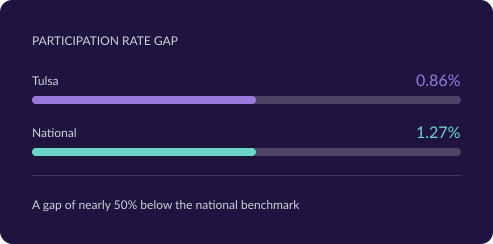
Between 2010 and 2024, the number of women in technology occupations in Tulsa grew by 47%, and women accounted for 65% of all net tech workforce growth between 2019 and 2024. Even so, men remain more than twice as likely to work in a technology role, and women in Tulsa participate in technology occupations at a rate of 0.86%, compared to 1.27% nationally, a gap of nearly 50%.
Increase in women in technology occupations in Tulsa over 14 years
Increase in women in technology occupations in Tulsa over 14 years
The full report includes detailed data tables, methodology notes, occupational breakdowns, and national comparisons.
The strongest employment gains have occurred among women aged 25 to 34 and 35 to 44, the key career-building years, where growth outpaced men in both cohorts between 2010 and 2024. However, significant disparities persist across every age group, and the concentration of growth among mid-career women raises important questions about whether younger women are entering technology pathways at the pace needed to sustain progress.
Key career-entry years
Peak career-building years
The concentration of growth among mid-career women raises important questions about whether younger women are entering technology pathways at the pace needed to sustain progress.
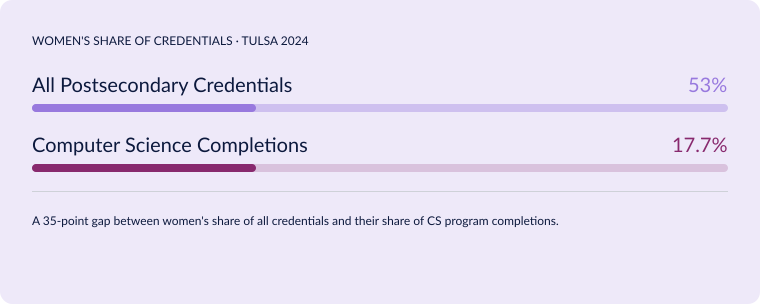
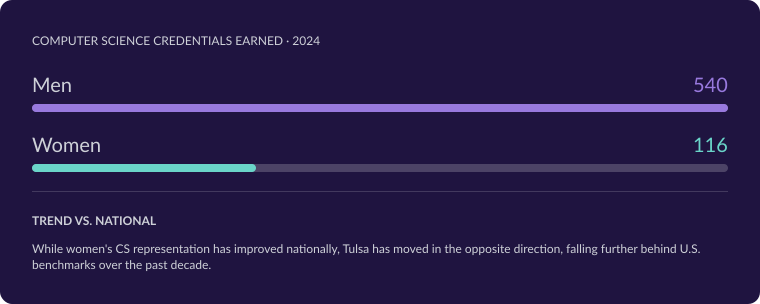
Women earn approximately 53% of all postsecondary credentials in Tulsa but account for only 17.7% of computer science program completions. In 2024, men earned 540 computer science credentials compared to 116 for women. While women's representation in computer science has improved nationally, Tulsa has moved in the opposite direction, falling further behind U.S. benchmarks over the past decade.
Women earn approximately 53% of all postsecondary credentials in Tulsa but account for only 17.7% of computer science program completions. In 2024, men earned 540 computer science credentials compared to 116 for women. While women's representation in computer science has improved nationally, Tulsa has moved in the opposite direction, falling further behind U.S. benchmarks over the past decade.
Increase in women in technology occupations in Tulsa over 14 years
Strengthening postsecondary and alternative pathways into computing through intentional program design.
Improving workforce entry, retention, and advancement through mentorship, sponsorship, and inclusive workplace practices.


